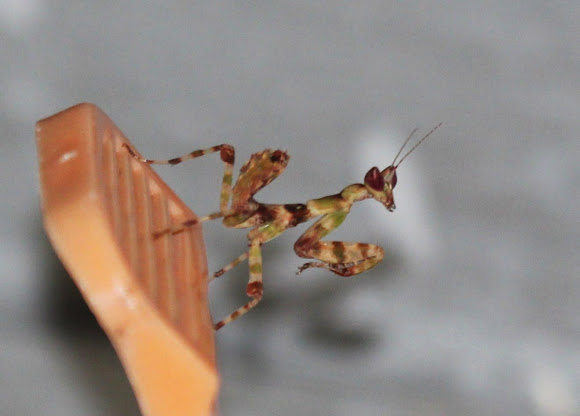
Mantidae sp.
First spotting found by my son. Mantis is an order of insects that contains approximately 2,200 species in 15 families worldwide in temperate and tropical habitats. Another name for the order in the United States is "praying mantises", because of the typical "prayer-like" stance, although the eggcorn "preying mantis" is sometimes used since mantises are predatory. In Europe and other regions, however, the name "praying mantis" refers to only a single species, Mantis religiosa. Mantises have two grasping, spiked forelegs ("raptorial legs") in which prey items are caught and held securely. The articulation of the head is also remarkably flexible, permitting nearly 300 degrees of movement in some species, allowing for a great range of vision. Mantises are exclusively predatory. They will only eat meat that they have caught themselves. Insects form the primary diet, but larger species have been known to prey on small scorpions, lizards, frogs, birds, snakes, fish, and even rodents; they will prey upon any species small enough to be successfully captured and devoured. Most species of mantis are known to engage in cannibalism which happens most frequently during mating season. As is the case with sexually cannibalistic creatures, it is the female that eats the male after mating. This is done to provide nutrients for the developing young, and in many species the male is willing to let it occur, although in some species the male may still retain its natural instinct to escape. Generally, mantises protect themselves by camouflage and concealment. When directly threatened, many mantis species stand tall and spread their forelegs, with their wings fanning out wide. The fanning of the wings makes the mantis seem larger and more threatening, with some species having bright colors and patterns on their hind wings and inner surfaces of their front legs for this purpose. If harassment persists, a mantis may strike with its forelegs and attempt to pinch or bite. As part of the threat display, some species also may produce a hissing sound by expelling air from the abdominal spiracles. Mantises, like stick insects, show rocking behaviour in which the insect makes rhythmic, repetitive side-to-side movements. Functions proposed for this behaviour include the enhancement of crypsis by means of the resemblance to vegetation moving in the wind. However, the repetitive swaying movements may be most important in allowing the insects to discriminate objects from the background by their relative movement, a visual mechanism typical of animals with simpler sight systems. Rocking movements by these generally sedentary insects may replace flying or running as a source of relative motion of objects in the visual field - wikipedia.org
Seen near flowering gardens.
The majority of mantises are ambush predators. They camouflage themselves and stand perfectly still. Then they just wait for their prey to stray too near. When a target does get close enough, the mantis then lashes out at remarkable speed, in fractions of the time it takes people to blink. Some ground and bark species, however, pursue their prey. Prey items are caught and held securely with grasping, spiked forelegs. The praying mantis usually holds its prey with one arm between the head and thorax, and the other on the abdomen. Then, if the prey does not resist, the mantis will eat it alive. However, if the prey does resist, the mantis will eat its head first, and then carry on with the body in peace. As their hunting relies heavily on vision, they are primarily diurnal, but many species will fly at night, especially males in search of less-mobile females whom they can detect through pheromones. Flying at night allows these males to avoid many diurnal bird predators, and many mantises also have an auditory thoracic organ that assists them as they attempt to avoid capture by bats by detecting the presence of the bat's echolocation sounds and responding evasively. Some mantises are able to detect the echolocation sounds produced by bats, and when the frequency begins to increase rapidly, indicating an approaching bat, they will stop flying horizontally and begin a descending spiral toward the safety of the ground, often preceded by an aerial loop or spin-Wikipedia.
Lat: 19.80, Long: 72.75
Spotted on Apr 14, 2012
Submitted on Apr 14, 2012
18 Comments
ok thnx
You can write on info@projectnoah.org or support@projectnoah.org
but how to extend it ?
Please do not solicitate spottings from the area which are beyond the boundary of your mission. Thanks. I will add to it once the boundary has been extended. Regards.
not at all its for India
but dont know how to extend area
Thanks Uday. I believe the missions radius is only 300miles?
add it to http://www.projectnoah.org/missions/1278... here
Thanks Mayra.
Wow!!
Thanks Jolly!
Great spotting! It looks like its ready to do a pandango!
Thank you Atul sir, Emma, Mayra and Sachin!
Very nice spotting Satyen,
Uau! Very diferent!!!
nice spot! great info too.
fantastic spotting!
Thanks a lot Gerardo. Edited and bought the second pic forward.
Very nice looks colorful on the second photo!