A worldwide community photographing and learning about wildlife

Project Noah Nature School

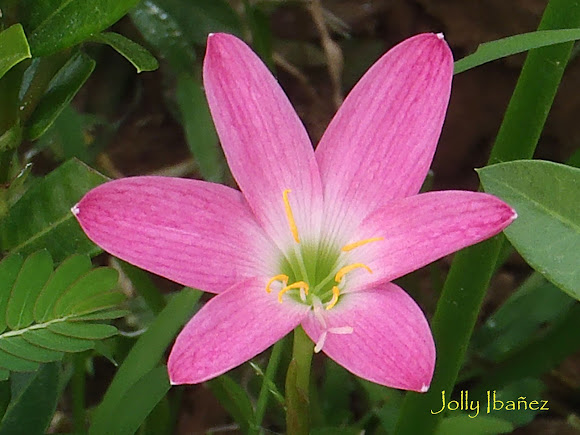
Zephyranthes rosea
Z. rosea are perennial herbaceous monocots. They are small plants, reaching only 15 to 20 cm (5.9 to 7.9 in) in height.[3] They bear five to six narrow and flattened dark green linear leaves, about 3 to 4 mm (0.12 to 0.16 in) wide, from spherical tunicate bulbs around 1.5 to 2.5 centimetres (0.59 to 0.98 in) in diameter.[4][5][6] The single funnel-shaped flowers are borne erect or slightly inclined on scapes around 10 to 15 cm (3.9 to 5.9 in) long. The spathes are around 2 to 2.8 cm (0.79 to 1.1 in) long and slightly divided only at the tip.[7] The fragrant six-petaled flowers are around 2.5 cm (0.98 in) in diameter and 3 to 3.5 cm (1.2 to 1.4 in) in length. The perianth is bright pink with a green central perianth tube that is less than 5 mm (0.20 in) long.[5][8][9] The six stamens are of different lengths – one of 11 mm (0.43 in), one of 16 mm (0.63 in), and four between 12 to 13 mm (0.47 to 0.51 in).[5] They are shorter than the style and inserted at the mouth of the perianth.[7] The anthers are 3 to 6 mm (0.12 to 0.24 in) long.[10] The flowers develop into capsules that are divided deeply into three lobes.[11] The seeds are shiny black and flattened.[4]
Z. rosea is native to the Caribbean, particularly Cuba, Puerto Rico, Guadeloupe, and Martinique.[13] It has been introduced and naturalized to tropical North America, Central America, South America, Asia, Australia, and some Pacific Islands.[27] They are common in recently disturbed land and grassy areas (like lawns and meadows) that receive periodical rainfall.[8][9]
The bulbs of Z. rosea, like other members of Zephyranthes and Habranthus, contain various toxic alkaloids including lycorine and haemanthamine.[29] They can cause vomiting, convulsions, and death to humans, livestock, and poultry.[16]

Spotted on Apr 29, 2012
Submitted on Apr 29, 2012










 +0
+0


