A worldwide community photographing and learning about wildlife

Project Noah Nature School

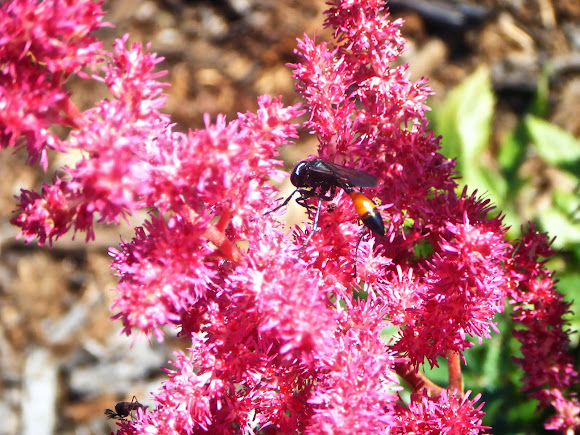
Sphex rufocinctus
The name "thread-waisted wasp" originates from the extremely narrow junction between the thorax and abdomen of these wasps. These wasps are well-known for practicing "mass provisioning" -- where progeny are provided with a "chamber" filled with the necessary sustenance for growth. Because many of these wasps are parasitoids, the "chamber" is often an organism such as a caterpillar, a spider, or even other wasps! These organisms will serve as a cozy home for developing offspring, supplying ample food (decaying tissues), and a somewhat impermeable barrier against the external environment.
Temperate regions of North America.
This species is easily mistaken for its European doppelgänger, the red-banded sand wasp (Ammophila sabulosa). One subtle difference between the two species, is the presence of golden hairs on Ammophila sabulosa (which is also thinner). There are no golden hairs on Sphex rufocinctus.

Spotted on Aug 6, 2012
Submitted on Aug 7, 2012










3 Comments
You're Welcome!
Sorry about that, S Frazier. I forgot the details of your mission (didn't recall that we had to have the progeny, and that parasitic brooding was not included). I'll be more stringent in the future!
Hello. This has been added to the Brooding behavior mission but unfortunately the provisioning (parasitism) is not the same thing as parental care. Thanks for removing it.