A worldwide community photographing and learning about wildlife

Project Noah Nature School

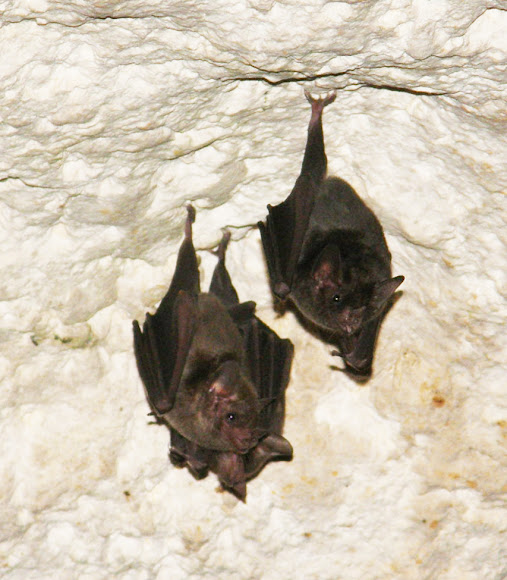
GLOSSOPHAGA SORICINA
Common Long-tongued Bats have long, slender tongues, and are the most commonly encountered nectar-feeding bats in Central America. Dark gray instead of the Jamaican Fruit Bat's rusty color, but it also bores a leafy flange above its nostrils
These bats eat moths and fruits in the wet season and nectar and pollen in the dry season. They roost in small to large groups in caves, tunnels, culverts, hollow trees and buildings, usually not in complete darkness. Individuals hang singly or in clusters. These bats where around 10 cm in size. They were in the caverns of Balankanche near Chichen Itza.

Spotted on Sep 12, 2011
Submitted on Sep 20, 2011










4 Comments
Fun fact! The common long-tongued bat has evolved an extremely efficient way of slurping up extra nectar from flowers. Its tongue is covered with scores of little hair-like structures that are instantly erected by blood flow; this dynamic action makes the tongue an effective “mop” for nectar and could even inspire new industrial designs, according to researchers from Browns University. Read more here - http://bit.ly/16PwzFM
https://www.facebook.com/photo.php?fbid=...
https://twitter.com/projectnoah/status/3...
Please consider adding this spotting to the new North American Bat Tracker mission at http://www.projectnoah.org/missions/1830...
Yes, I wonder too...
Cool photo(s)! Those bats must have some strong leg muscles!