A worldwide community photographing and learning about wildlife

Project Noah Nature School

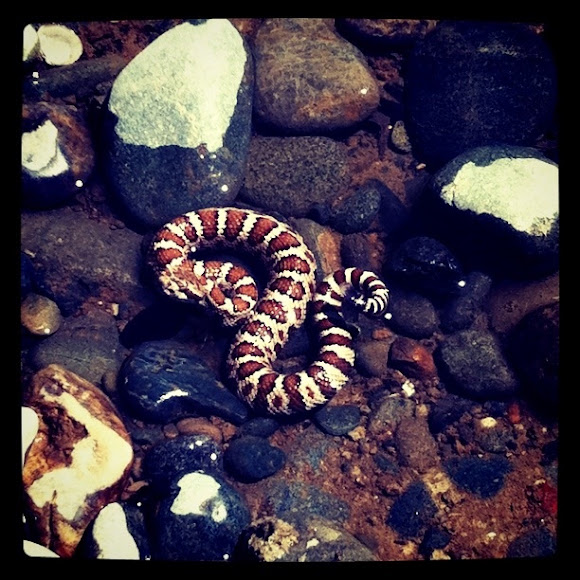
Crotalus oreganus lutosus
A venomous pit viper subspecies. The Great Basin rattlesnake is not a large snake, adults range in size from 15" to 36" with the rare individual a few inches larger than three feet. The Great Basin rattlesnake displays many different color variations throughout its range. He was little guy, taking a swim across the river from an island. His little rattle was still growing in.
Sacramento River a venomous pit viper subspecies found in the Great Basin region of the United States. This area stretches from parts of eastern California east into Western Colorado, from south Nevada north into southeastern Oregon.


Sacramento is only a few hours from Fresno and Yosemite and the basin is the only pit viper in the area of the into national Forrest and u can find the Great Basin over 150 miles from mammoth Yosemite or bridge port I find them in the high deserts as well right above Lancaster
It looks to be a Great Basin especially with u in northern Cali the Pacifica have yellow on there rattles and basin has a solid black rattle if u look at the rattle its all black tht is a perfect indication that it is not a southern or northern
This is a neonate C. o. oerganus, it is unquestionably NOT not C. o. lutosus. Aside from the geographic locality of where the neonate was found, phenotypical identity is conclusive.
If you really found this in Sacramento I am pretty positive this is a Northern Pacific Rattlesnake, which is really the only Crotalus species we have in this area.
http://www.californiaherps.com/snakes/pa...

I'll try to crop the head for you, I was trying to get close shots with just my iphone, so it was difficult, but I didn't want to scare him.

Based on the body shape and posture I'd also vote rattlesnake. Not sure exactly which species, but probably Crotalus viridis

There are different morphs (colours) if you Google the words corn snake - you'll see the different morphs. Interestingly (or not) there's a cline in this species from the east to west coast in America, with a difference in the number of ribs, very early steps on the route to possible speciation.

Spotted on Apr 23, 2012
Submitted on Apr 23, 2012