A worldwide community photographing and learning about wildlife

Project Noah Nature School

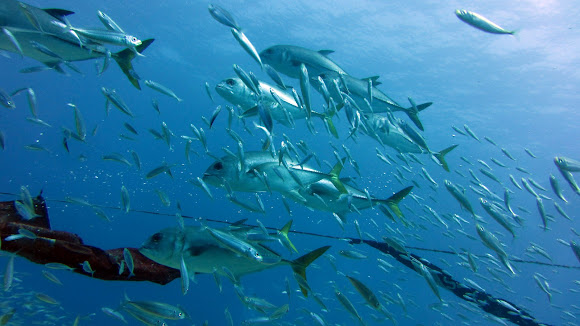
Caranx latus
Photo take at -70 ft on a ship wreck this school of jacks that is always around the wreck today in particular we have clear water and strong currents so it was full of life. The horse-eye jack, known for its proportionally large eyes, commonly has 8-9 spines on its dorsal fin and 20-22 dorsal rays. The anal fin contains two or three spines and 16-17 rays. The pectoral fins are without spots, although they can may have a spot on their gill covers. Their scutes are dark in color and can be found on the tail of the fish. The caudal fin is bright yellow, while the crevalle jack's caudal fin has a slightly darker yellow tinge. Young individuals have large, dark bars on their bodies.
Horse-eye jack are commonly found in the subtropical Atlantic ocean from Bermuda and the northern Gulf of Mexico south to Rio de Janeiro. In the eastern Atlantic, they are found from St. Paul's Rocks to Ascension Island and, rarely, the Gulf of Guinea. Horse-eye jack are pelagic. They can be found on reefs and off shore rigs. Juveniles can be found close to shore along sandy and muddy bottoms. Horse-eye jack are known to penetrate brackish water and can live in the mouths of some rivers. They are typically found in salt water up to 140 m in depth.

Spotted on Jul 6, 2012
Submitted on Jul 6, 2012










No Comments