A worldwide community photographing and learning about wildlife

Project Noah Nature School

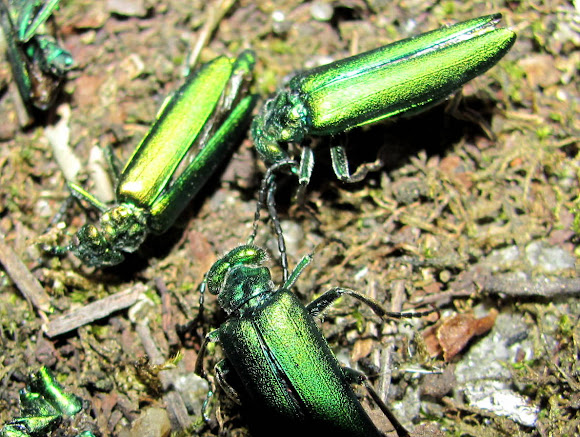
Lytta vesicatoria
The Spanish fly is an emerald-green beetle in the family Meloidae, Lytta vesicatoria.[1] Other species of blister beetle used by apothecaries are often called by the same name. Lytta vesicatoria is sometimes incorrectly called Cantharis vesicatoria, but the genus Cantharis is in an unrelated family, Cantharidae Lytta vesicatoria is 15 millimetres (0.59 in) to 22 millimetres (0.87 in) long and 5 millimetres (0.20 in) to 8 millimetres (0.31 in) wide. Adult beetles feed on leaves of ash, lilac, amur privet and white willow trees; larvae are parasitic on the brood of ground nesting bees.
The beetle lives in scrublands and woods throughout southern Europe and eastward to Central Asia and Siberia http://click.infospace.com/ClickHandler....
Cantharidin, the principal irritant in Spanish fly, was first isolated and named in 1810 by Pierre Robiquet, a French chemist then living in Paris, from Lytta vesicatoria. Robiquet demonstrated that cantharidin was the actual principle responsible for the aggressively blistering properties of the coating of the eggs of that insect, and established that cantharidin had very definite toxic and poisonous properties comparable in degree to that of the most violent poisons known in the 19th century, such as strychnine.[6] Cantharidin, a terpenoid, is produced by various insect species. The body of the beetle contains up to 5% cantharidin. The crushed powder is of yellowish brown to brown-olive color with iridescent reflections, of disagreeable scent and bitter flavor. [edit] spotted in river homem félinhos beach,it's a kind of beatle cemitery,lot's of red metalic beatles

Spotted on Jul 10, 2012
Submitted on Jul 13, 2012










7 Comments
Thanks António. Keep up the interesting posts!
Thanks Bee,Jacbs for the id,you naill it and thanks again Marinus for your concern
Hi António. I was looking at these beetles. It seems like they could be a type of blister beetle. I found a link for a possible species below on the encyclopedia of life. I'm not sure what other related species they might be close to. Thanks for the wonderful post.
http://eol.org/pages/1220034/overview
Thanks Jellyfish and Marinus for the comments i'll tried to search based in your comments
I think those Beetles are Tiger Beetles?
Thanks very much Dan,when we found them at first,from 2m distance we supose they where alive,they where in a granite rock full of moss ,i have a spotting in my files of this one alive,i have to edit the photos to post it ,thanks again for your allways nice words :)
Spectacular Antonio! So cool that there are so many.