A worldwide community photographing and learning about wildlife

Project Noah Nature School

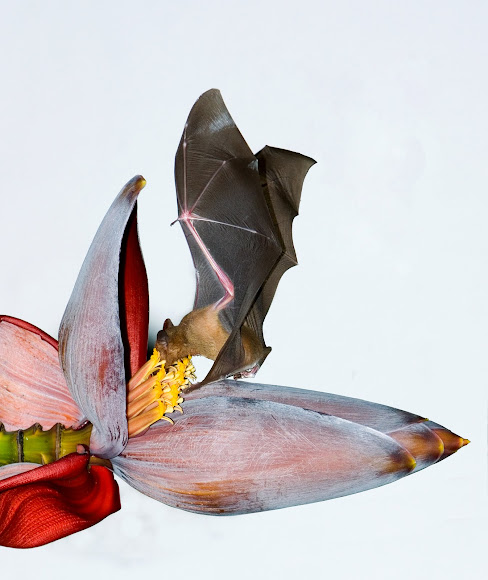
Artibeus jamaicensis
A fruit Bat hanging out at the ever popular banana tree in front of my house
This photo was taken at night w/external flash in high sync mode. 1/640-f6/7

Spotted on Jun 26, 2011
Submitted on Jun 26, 2011










41 Comments (1–25)
This photo deserves SOTD...
Excellent shot...
wow! this is excellent!
Excellent shot! Probably one of the nectar bats, Leptonycteris or Choeronycteris
WOW! I love this amazing photo!
Please consider adding this spotting to the new North American Bat Tracker mission at http://www.projectnoah.org/missions/1830...
Great photo!
Wonderful shot and Congratulation on the SotD !
The Jamaican fruit-eating bat has a unique breeding pattern, closely tied to seasonal peaks in food opulence. In some locations, the species may breed year-round, but in other areas the female usually gives birth twice a year, to a single young at a time, with the births coinciding with periods of peak food availability (usually at the end of the wet season). Although the usual gestation period is 3.5 to 4 months, during the second pregnancy of the year the embryo is able to become dormant, delaying normal development for up to 2 months, so that overall development takes up to 6 months and the young is born when conditions are more favorable. The female mates again soon after giving birth . The young bats start to fly at around 31 to 51 days old, and reach adult size after about 80 days. Sexual maturity is reached at 8 to 12 months, and this species may live for up to 9 years in the wild.
There is peculiar behavior shown by adult female Jamaican fruit-eating bats usually roost together in small ‘harems’ of up to 14 or more individuals plus their young, defended by one or occasionally two adult males . These harems usually roost in tree hollows, or close together in caves, and the male spends much of its time close to the roost site, keeping away rivals. Small groups of bachelor males or juvenile females also form, often roosting in vegetation or in leaf ‘tents’, or in separate parts of caves. However, these groups are less stable than the harems and often shift roosting site. Juveniles of both sexes leave the harem group before reaching adulthood .
Congratulations John, this spotting is featured in the Project Noah blog today http://blog.projectnoah.org/post/3470520...
Thank you. Twice!
Cool spotting!!
This is amazing!
Incredible capture!!!!
lovely photo!
Wonderful Spotting, Great shoot !!
Nice pic!
woooow
Very nice shot
Fantastic photo!
wow
Thank you. Oz meaning Australia?
Great shot John, over in Oz nearly all the fruit bats are large (600g-1Kg), I hadn't seen such a small frugiverous bat before. Thanks.
Wonderful shot!!
have never seen this type of shot amazing work done
Viewing it in a Large Format its overwhelming. Fantastic. Thanks for sharing.