A worldwide community photographing and learning about wildlife

Project Noah Nature School

Eumorpha pandorus
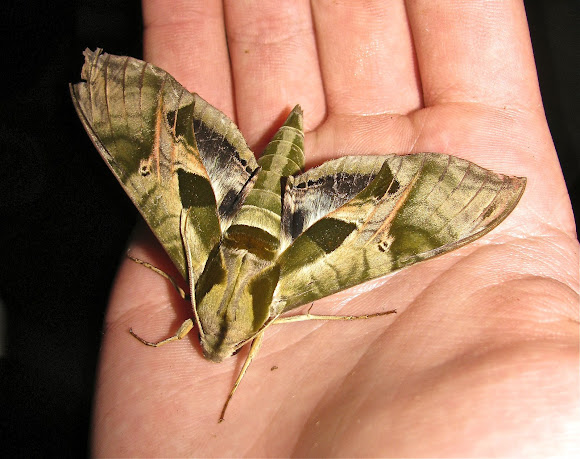
First described in 1806 by Jacob Hübner as Daphnis pandorus (In relation to the Asian counterpart, Daphnis nerii), the Pandora Sphinx Moth, Eumorpha pandorus, is a lovely olive green moth, with darker green patterning on the inside of the forewing, around the head, and lower on the forewing. There are sometimes pink marks near the body of the moth and on the hind wing. The hindwing is mainly white with a black spot, usually in a blotchy pattern.
Larvae, which are quite variably colored, feed on: Grape and Virginia Creeper
This was #1 on my moth hunting (no kill) list! I cannot believe I saw it! My friend called me yesterday and said she found a huge moth at her house yesterday. She texted me a photo and I identified it for her, and told her if she finds it again, she could let me know. Sure enough, she found this and another sphinx moth (Sphinx kalmiae, I believe) again tonight. She offered to bring them over, and when I saw them, I was amazed! The moth is so amazing! This moth won the Winkflash Nighttime Photo Contest, which ended August 28th, 2012. Thanks to all who voted!

Spotted on Jul 19, 2012
Submitted on Jul 20, 2012










41 Comments (1–25)
Karen, thank you so much for featuring this moth for the fun fact! It's one of my most favorite finds so far!
Fun fact! There are more than 11,000 moth species in the U.S. alone! https://upload.facebook.com/projectnoah/...
You can help us document them by participating in National Moth Week, July 19 – 27 2014. You can learn more and sign up here http://nationalmothweek.org/registration...
:)
Thanks again, Uday! No problem!
welcome!
btw thanks for following me :)
Thanks so much, Uday! I was surprised you liked the second photo the best! I thought it had a tad too much exposure! Thanks again for your nice comment!
nice series
loved second pic most!
Thanks, Fyn!
Cool!
Thanks Noel and António!
Congratulations J!
Congrats J :)
This moth won the Winkflash Nighttime Photo Contest, which ended August 28th, 2012. Thanks to all who voted!
Thanks so much, Argy!
Fabulous moth and nice shots too J.
Thanks, Neil! I'm glad you liked my mini research paper! :)
Awesome spotting Jake! I love the photos and the descriptive notes!
Thank you, Mayra!
Fabulous!
After more research, finding the gender of sphinx moths seems very difficult. It seems like a pinned specimen would be ideal to find the gender, though I will submit to www.BugGuide.net, and see if they will be able to help. Thanks again, Karen!
Thanks Karen! I'll do some looking into that! Thanks again!
Hi Jacob, only males have both an undivided frenular hook and a retinaculum. Also all male hawk moths have a partial comb of hairs along their antennae (from Wiki http://en.wikipedia.org/wiki/Sphingidae)
Does anyone know how to tell if the Pandora Sphinx Moth is a male or a female? I know antennae is a common indicator, but sphinx moths really don't have much of a variation on the antennae. Any help would be greatly appreciated.
Thanks, Louisa! It was definitely something not to forget!
Congrats on spotting #1 on your moth list! Awesome!