A worldwide community photographing and learning about wildlife

Project Noah Nature School

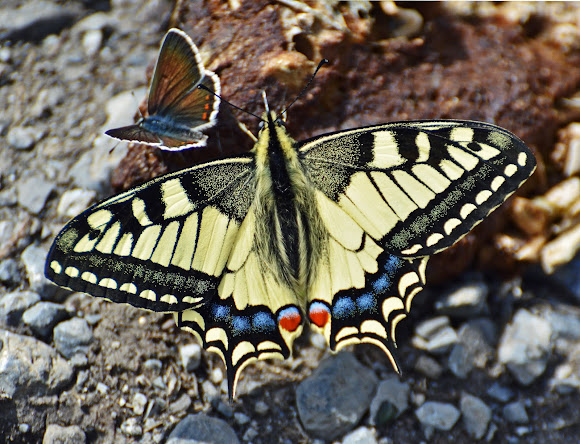
Papilio machaon
Not restricted to the old world despite its common name, this spectacular large butterfly has yellow wings with black vein markings, a pair of protruding tails on the hind wings and just below each tail a red eye spot. In decline and protected in my area. Spotted here 1900 m above sea level.
Present throughout the entire Palearctic region, ranging from Russia to China and Japan, and across into Alaska, Canada, and the United States.
I am still trying to ID the butterfly on the top rileft corner of the first and second shots; quite distinctive brown with a white fringe and pairs of orange spots. The other butterfly on the second shot is Aglais urticae. You wish your butterflies shots would include pretty flowers but these guys were working on a piece of decomposing organic matter.

Spotted on Jun 15, 2011
Submitted on Jun 17, 2011










28 Comments (1–25)
gorgeous!
The ID of the butterfly on the top left corner was confirmed as Aricia artaxerxes by Vincent Baudraz from www.lepido.ch
Thank you - merci!
Thanks you gatorfellows! I visited the same place 2 days ago and saw the same 3 species again.
If you are still trying to identify the small butterfly with the fringe, you might consider a female Common Blue (Polyommatus icarus). Females are brown with a row of red spots along the edges. Very nice series of photos.
Thank you!
Beautiful picture Daniele!
Thanks for the comment and extra info KarenL! For the extra butterfly on the top right I'm not sure about Aricia agestis: in this species both sexes have a band of orange spots at the border of each wing. Here it is limited to the lower wings. On the basis of this and the fact that it was found at altitude, I think it is Aricia artaxerxes (mountain brown Argus). Subtle differences... What do you think?
http://en.wikipedia.org/wiki/Brown_Argus...
http://www.eurobutterflies.com/species_p...
Lovely series! Male butterflies 'puddle' in mud, manure & decomposing organic matter to obtain necessary minerals that they can't get through nectar or sap. The other butterflies are a small tortoiseshell (Aglais urticae) & a brown argus (Aricia agestis).
Thanks textless!
Great photos.
Thanks Pulkit and Arlanda!
beautiful pics!
beautiful colors !!!
Thanks Harsha!
Lovely!
Thanks Outdoor Imagery! The butterfly is doing all the work...
No worries HeatherMiller. I thought indeed you may have been thinking about the Eastern tiger swallowtail, which you have in the US and we don't have in Europe. It got me checking further and I found the wonderful swallowtails.net website. That's the wonderful way Noah works!
DanielePralong, I had it backwards anyhow...based on my very limited knowledge which was
Wikipedia...http://en.wikipedia.org/wiki/Eastern_tiger_swallowtail
The blue spots were on the females in this reference. Your reference is much more detail than Wikipedia.
Hi HeatherMiller, thanks for checking back. Old World Swallowtail and Common Yellow Swallowtail are both accepted common names for Papilio machaon, which is why I indicated both. Indeed, the link indicates that both males and females can have blue. There must be another way to tell the sexes apart so I'd be glad if anybody knows. I think that the specimen on the link were IDed post-mortem using a microscope to examine genitalia.
DanielePralong - awesome link. I guess the blue doesn't always mean it's a male. Can you have both an Old World Swallowtail AND a Common Yellow Swallowtail? Is it an either/or type of thing based on location the critter was spotted? I have no idea, but am thinking that is the way to tell, perhaps?
Thanks Meik!
Awesome pictures and neat presentation! Thanks for sharing!
Thanks for your comment Heather. Does this apply to Old World swallowtails though? Have a look at
http://www.swallowtails.net/P_machaon.ht...
It's a male Swallowtail (blue dots on back tail wings).
Thank you very much Ann!