Project Noah

Project Noah is a tool to explore and document wildlife and a platform to harness the power of citizen scientists everywhere.

Join Project Noah Today

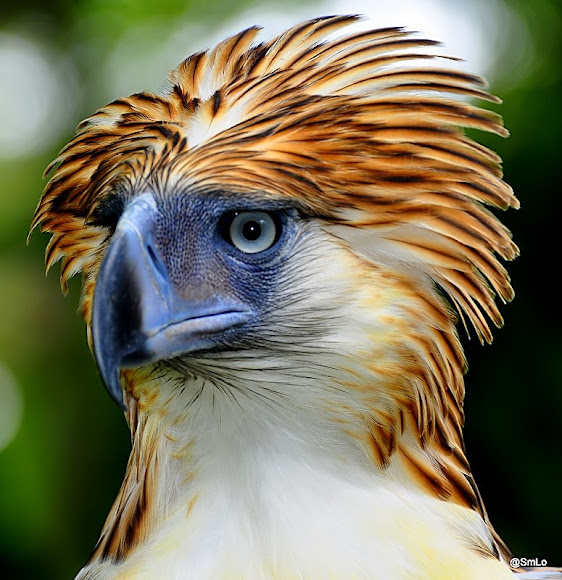
Philippine Eagle

Pithecophaga jefferyi

Habitat:

These pictures were shot at Philippines Eagle Center of Davao.

Notes:

Also known as the Monkey Eating Eagle.

1 species ID suggestions

DiveMUster
DiveMUster 2 months ago
Philippine Eagle
Pithecophaga jefferyi Philippine Eagle

113 Comments (1–25)

AshishNimkar
AshishNimkar 3 days ago

Great work...
Shauming..!!

ShaumingLo
ShaumingLo 4 days ago

Thanks Pamsai and Galantlive.

Galantliv
Galantliv 4 days ago

Nice hair-do :)

pamsai
pamsai 4 days ago

what a hairstyle!

ShaumingLo
ShaumingLo 4 days ago

Thanks Beelover and Vipin.baliga

vipin.baliga
vipin.baliga 5 days ago

Unbelievably beautiful..!!!
such a majestic bird....!!!
A Masterpiece.... :-)

Beelover
Beelover a week ago

Wow! That eagle's fierce looks inspiring!

ShaumingLo
ShaumingLo 2 weeks ago

Thanks Prachishah.

PrachiShah
PrachiShah 2 weeks ago

Wonderful Shot....

ShaumingLo
ShaumingLo 3 weeks ago

Thanks Nicholas4, never expect this spotting can fly so high.

Nicholas4
Nicholas4 3 weeks ago

A "Coronation" of sorts!
Godspeed!
Thanks for Sharing it ShaumingLo

ShaumingLo
ShaumingLo 3 weeks ago

Thanks DanielePralong for all your support and encouragement, and also Marsya Christyanti too.

Marsya Christyanti
Marsya Christyanti 3 weeks ago

Wow, extremely unusual diet for a bird

DanielePralong
DanielePralong 3 weeks ago

Congratulations ShaumingLo! I just love this shot. Hoping to see more from you in 2012!

ShaumingLo
ShaumingLo 3 weeks ago

Thanks Kadavoor for the WOW!

ShaumingLo
ShaumingLo 3 weeks ago

Thanks Atul. For all your support.

SanjaySaklani
SanjaySaklani 3 weeks ago

Hey Shaum that is no mention for such a beautiful spotting I have some more information you can upload it to the spotting:
Description:
The Philippine Eagle's nape is adorned with long brown feathers that form a shaggy crest. These feathers give it the appearance of possessing a lion's mane, which in turn resembles the mythical griffin. The eagle has a dark face and a creamy-brown nape and crown. The back of the Philippine Eagle is dark brown, while the underside and under wings are white. The heavy legs are yellow with large, powerful dark claws, and the prominent large, high-arched, deep beak is a bluish-gray. The eagle's eyes are blue-gray. Juveniles are similar to adults except that their upper part feathers have pale fringes.

The female is up to 112 centimeters (3.82 ft) long with an average of 102 centimeters (3.36 ft) long and weighs about 7 kilograms (15.5 lb). The adult male is about 10 to 20% smaller and averages at about 91 centimeters (3 ft) and 5 kilograms (11 lb). The Philippine Eagle is the world's largest living eagle in terms of length. The species has a wingspan of approximately 2 meters (6.6 ft). The wings of this eagle are shorter than large eagles of open country (such as the Martial Eagle, Wedge-tailed Eagle and Steller's Sea Eagle), but are quite broad and have a greater surface area than any other eagle.

The most frequently heard noises made by the Philippine Eagle are loud, high-pitched whistles. Additionally, juveniles have been known to beg for food by a series of high-pitched calls.
Habitat and Behavior

The Philippine Eagle is endemic to the Philippines and can be found on four major islands: eastern Luzon, Samar, Leyte and Mindanao. The largest number of eagles resides on Mindanao, with between 82 and 233 breeding pairs. Only six pairs are found on Samar, two on Leyte, and a few on Luzon. It can be found in Northern Sierra Madre National Park on Luzon and Mount Apo and Mount Kitanglad National Parks on Mindanao. Some Palawan natives have claimed that the Philippine Eagle does exist in the island province. Some are under care of the Palawan Crocodile Farm.
This eagle is found in dipterocarp and mid-montane forests, particularly in steep areas. Its elevation ranges from the lowlands to mountains of over 1,800 meters (5,905 ft). It is estimated that only 9,220 square kilometers (2,280,000 acres) of old growth forests remain in the bird's range. However, its total estimated range is about 146,000 square kilometers (56,000 sq mi)

Evolution in the Philippine islands, without other predators, made the eagles the dominant hunter in the Philippine forests. Each breeding pair requires a large home range (of 25 to 50 square miles) to successfully raise a chick, and thus the species is extremely vulnerable to the regularly occurring deforestation.

Notes:
The Philippine Eagle was known initially as the Philippine Monkey-Eating Eagle because it was believed to feed on monkeys exclusively; this has proven to be inaccurate. The primary prey varies from island to island depending on species availability, particularly in Luzon and Mindanao. This is due to the islands being in different fauna regions. For example, Philippine flying lemurs, the preferred prey in Mindanao, are absent in Luzon. The primary prey for the eagles in Luzon is currently unknown. The eagles prefer flying lemurs and Asian Palm Civets, but they occasionally eat small mammals, birds (owls and horn bills), reptiles (snakes and monitor lizards), and even other birds of prey. There have been reports of eagles capturing young pigs and small dogs. It is estimated that the flying lemur could make up 90% of the raptor's diet in some locations.

Eagle pairs sometimes hunt troops of monkey cooperatively, with one bird perching nearby to distract the primates allowing the other to swoop in unnoticed for the kill.

“Pag-asa’s” popular eaglet is named “Pagkakaisa” meaning unity.

Atul
Atul 3 weeks ago

congrats Shauming !! truely one of my favorites !!

ShaumingLo
ShaumingLo 3 weeks ago

THanks for the info SanjaySaklani.

Ismael Chaves
Ismael Chaves 3 weeks ago

I love this spotting and your hornbills too

SanjaySaklani
SanjaySaklani 3 weeks ago

The Philippine Eagle, Pithecophaga jefferyi, also known as the great Philippine eagle or monkey-eating eagle, is among the tallest, rarest, largest, and most powerful birds in the world. A bird of prey belonging to the family Accipitridae, it is also known as "Haribon" or "Haring Ibon," which means "Bird King". Its local name is banog.

ShaumingLo
ShaumingLo 3 weeks ago

Thanks IsmaelChavesAguilar, what an HONOR from Project Noah.

kadavoor
kadavoor 3 weeks ago

Wow!

Ismael Chaves
Ismael Chaves 3 weeks ago

Congratulations Shauming! you deserve it!

ShaumingLo
ShaumingLo 3 weeks ago

Thanks Nopayahnah.

Davao del Sur, Philippines

Lat: 7.19, Long: 125.46

Spotted on Aug 14, 2010
Submitted on Dec 14, 2011

Reference

Related spottings

Philippine Eagle Philippine Eagle-Owl Philippine Hawk Eagle Philippine Eagle

Nearby spottings

Brahminy Kite Golden Orb-web Spider Winged bean Fruit Bats