A worldwide community photographing and learning about wildlife

Project Noah Nature School

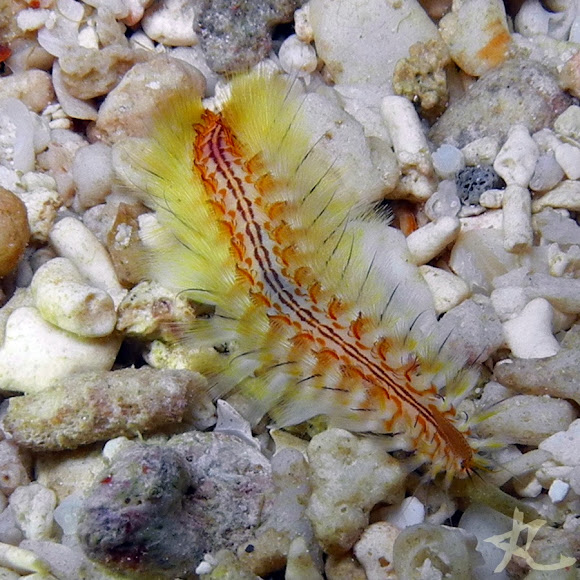
Chloeia fusca
Fire worms, also called bristle worms, are called such thanks to the poison found in the hollow hairs on their bodies. This provides protection against predators in a way similar to the irritant hairs on many caterpillar species.
I saw several of these during a night dive at Dayang Beach, Talikud Island. This one I spotted at a depth of around 10m. They look like flattened caterpillars and burrow into the sand.

Spotted on May 26, 2012
Submitted on May 28, 2012










37 Comments (1–25)
Thanks, Cindy and Kei!
Wonderful series Blogie!
Amazing!
Thanks, Harsha and Karen! :)
Awesome spot Blogie!
Blogie you drowned a caterpillar! Haha.. This is so beautiful. Those tiny feather like structures make it amazing.
Thanks, rat.tumour and AshishNimkar!
Super spotting..!!
The bristle worms I was handling on the Greek island of Kos (a different species to this one Blogie found) don't have much of a sting: You don't feel it at the time and later on it just felt a bit like a rash of faint nettle stings if that
Thank you very much, Mayra, williefromwi and Gerardo! :)
Wow fantastic great shots as usual Blogie!
fantastic
Wow! Incredible!!
Thanks, coti1 & manuelap1!
Good discussion guys. :)
Thanks, Jolly!
Btw, since you take underwater photos as well, I'd like to invite you to be part of the Philippine Coral Survey mission. Here's the link:
http://www.projectnoah.org/missions/8644...
Take a look at this one http://reefguide.org/chloeiafusca.html
Let's console ourselves with the realization that even scientists themselves sometimes disagree on nomenclature, species classification, distribution and all that! :D
Ok. I think you got it. The sites that I've seen has conflicting reports.
Jolly, I doubt very much that EOL's species distribution data are 100% accurate, or that a species won't be found anywhere outside what EOL declares. This is because they are entirely dependent on people submitting information to their databases. Even they themselves say that their records "may not represent the entire distribution." So, if it's on the sole basis of distribution, I don't think we can make a case for C. viridis here, nor a case against C. fusca.
Pending more data, I'll keep this spotting under Chloeia fusca for the time being.
Here's a link to show the range of C. viridis. http://eol.org/pages/459292/maps
Hi Jolly. I've seen pictures of C. viridis and they don't seem to match my spotting. On the other hand, take a look at the link below -- it shows C. fusca spotted in the Philippines:
http://www.richard-seaman.com/Underwater...
What do you think?
This could be Chloeia viridis because C. fusca is found somewhere in Africa.
Well adorned worm! Very beautiful!
I do believe you've nailed it, ArgyBee! :)